
Why We Stood at the Crossroads of Education. | The Gift of Time
The journey of fatherhood doesn’t begin when you first hold your child; it begins the exact moment you hear the words, “You are going to be a father.”
In that single, breathtaking second, a profound shift occurs inside you. Your brain stops thinking only about your own survival and immediately starts building a fortress of safety for a tiny life you haven't even met yet.
That is exactly what happened to me.
My name is Vipul Pradhan. I am, in every sense of the word, a product of the Indian middle class. Born in Thane, educated across the academic hubs of Pune and Navi Mumbai, I did what every young graduate from my background is conditioned to do: I took the very first job available right after graduation. In a middle-class household, survival comes first. Your personal dreams, your creative impulses, your wild ideas—you quietly fold them up, put them in a drawer, and start earning to support yourself and your family. You join the race because you don't know any other way.
But then came that life-altering news. A baby was on the way.
Suddenly, my mind became an intense planning center. Amidst all the thoughts of financial planning and stability, one massive question began to consume me: Education.
Initially, my plan was simple and rooted in my own background. I studied in a vernacular medium, and I valued that deeply. So, I thought, “We will put our child in a good Marathi medium school near Pune.” It felt safe. It felt familiar.
Then, Pratham was born.
When he reached the stage where he started crawling around the house, exploring every corner with boundless curiosity, I stopped looking at education through the lens of tradition and started looking at it through the lens of data and reality. I became a man possessed by research. I read dozens of educational articles, watched hours of expert videos, and analyzed internal reports from the education department.
The deeper I went, the more alarmed I became. I realized that the modern conventional schooling system isn't designed to educate; it is designed to mold children into predictable, compliant cogs for a corporate wheel. It is a beautifully packaged trap.
I looked down at my crawling son and thought: Why should I force him into a race before he even knows who he is?
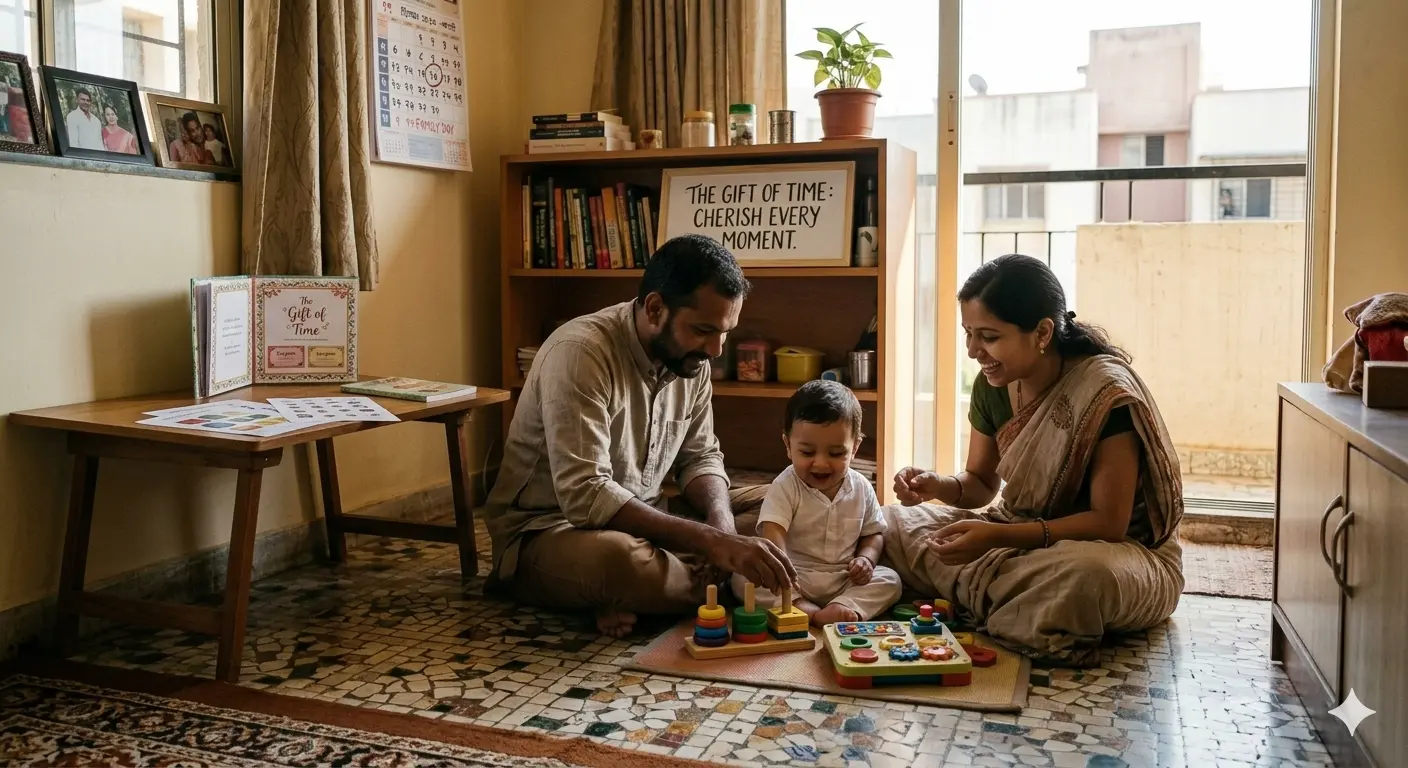
Swati and I made a radical decision. We decided to give Pratham his childhood back as a gift. We wanted him to own his time, to play without the shadow of a ticking clock, to enjoy his early years completely, and to grow into a young adult who has the clarity and confidence to choose his own career on his own terms.
It sounds beautifully simple when written on paper. In reality, it meant declaring war on societal norms. To pull this off, we had to fight and win three distinct battles.
Battle 1: The Partner Alignment
The first and most critical battle is always within your own home. If a couple is divided on how to raise a child, the child becomes the casualty. Thankfully, Swati has known me for a very long time. She understands the rhythm of my thoughts. Deep down, she had been harboring the exact same quiet rebellion. She too felt that a child’s life should look vastly different from the daily stress of school uniforms, heavy bags, and rote homework. When she looked at my research, she didn't see an eccentric husband; she saw a partner ready to protect their son's future. With Swati aligned, the foundation was solid. Battle one was won.
Battle 2: The Inner Circle
The next step was much harder: informing our parents that Pratham would not be attending nursery, playgroup, or even the local anganwadi.
In India, grandparents are deeply invested in a child’s upbringing, and their fears come from a place of pure love. To make things more intense, Swati’s mother was a primary school teacher. She spent her entire life working inside the system. Because of her profession, she knew the deep flaws and the suffocating nature of modern schools better than anyone—but she also had a practical, deeply maternal fear: “What if Pratham falls behind other children? What if he doesn't learn to read or write at the right age?”
We didn't dismiss her fears. We listened with empathy. We explained our vision patiently, showing them that stepping away from school did not mean stepping away from learning. Because our parents trusted our integrity and saw our commitment, their anxiety turned into confidence. They chose to believe in us. Battle two was won.
We had won the battle at home, and we had won the battle with our immediate family. But the world outside our front door was watching.
The third battle the biggest, loudest, and most relentless one—was just about to begin.
Let’s talk about that third battle in the next blog.